

Data last verified: March 2026
Florida vendor and supplier contract disputes resolve most efficiently through a structured four-step escalation path: direct negotiation, mediation, arbitration, and — only when all three fail — circuit court litigation.
Florida commercial mediation resolves most B2B contract disputes in 2 to 6 weeks at a total cost of $1,500 to $8,000, compared to 18 months to 3 years and $25,000 to $150,000 or more for circuit court litigation.
Florida B2B contract disputes are governed by Article 2 of the Florida Uniform Commercial Code for goods contracts under Chapter 672 of the Florida Statutes and by Florida common law contract principles for service agreements.
Stop paying litigation costs on disputes that mediation resolves in weeks. David L. John, Florida Certified Circuit Court Mediator, serves South Florida businesses at commercialdisputeresolutiongroup.com.
Florida B2B vendor and supplier contract disputes cluster around four primary categories: non-delivery, non-payment, quality failures, and scope disagreements. Each category triggers distinct legal rights under Florida law and distinct documentation requirements before mediation begins.
A Florida vendor who fails to deliver goods by the contractually specified date breaches the delivery obligation. Florida Statute 672.601 gives the buyer the right to reject non-conforming goods, accept them with a price reduction, or cancel the contract and pursue consequential damages.
For service contracts, Florida common law governs, and the non-performing party faces liability for the cost of obtaining substitute performance.
A Florida buyer who withholds payment under a completed vendor contract triggers a breach-of-contract claim for the unpaid amount plus interest. Material contract breach principles determine whether non-payment is justified by the vendor’s own performance failures or constitutes an independent breach by the buyer.
Florida Statute 672.314 imposes an implied warranty of merchantability on goods — goods must be fit for the ordinary purposes for which they are used. For service contracts, Florida common law imposes a standard of reasonable workmanship.
Quality disputes frequently involve competing interpretations of contract specification language, making the written contract the starting document for every mediation session.
Florida vendor contract scope disputes arise when the parties disagree on what work the contract requires, what constitutes a change order, or whether the vendor completed all required deliverables. Scope disputes are the most common trigger for design-build and construction contract disputes and arise with equal frequency in technology services and professional consulting agreements.
Florida B2B vendor contract disputes move through four resolution options in ascending order of cost, formality, and time. Direct negotiation resolves minor vendor disputes without third-party involvement.
Mediation resolves most significant disputes in weeks. Arbitration resolves disputes requiring a binding decision in months. Litigation resolves disputes requiring court intervention in years.
| Option | Timeline | Total Cost | Privacy | Outcome Control |
| Direct negotiation | Days–2 weeks | Minimal | Full | Both parties |
| Mediation | 2–6 weeks | $1,500–$8,000 | Full | Both parties |
| Arbitration | 3–12 months | $15,000–$60,000 | Full | Arbitrator decides |
| Circuit court litigation | 18 months–3+ years | $25,000–$150,000+ | Public record | The judge or jury decides |
Florida businesses that litigate vendor disputes without first attempting mediation typically arrive at a court-ordered mediation 18 months and $30,000 to $60,000 later — paying the full cost of litigation to reach the same table they could have reached in week three.
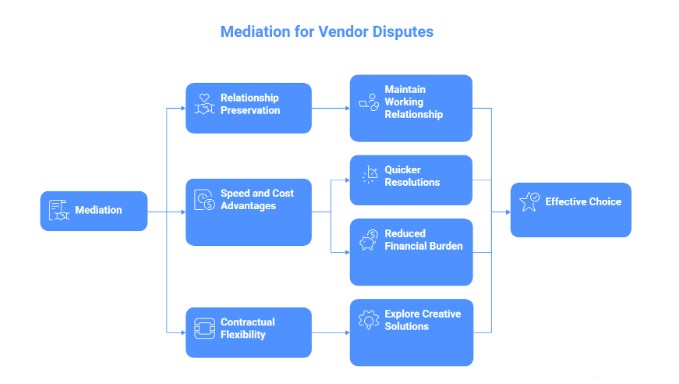
Florida commercial mediation is the preferred resolution path for B2B vendor disputes because vendor relationships generate recurring revenue that litigation permanently terminates.
A Florida business that litigates a $75,000 vendor payment dispute destroys a supplier relationship that may generate $500,000 in annual procurement value.
Florida vendor dispute mediation delivers three advantages over arbitration and litigation:
Florida B2B vendor relationships represent contracted supply chain capacity, negotiated pricing, and institutional knowledge that replacement vendors cannot replicate immediately.
Mediation produces outcomes that both parties construct together — a payment plan, a quality remediation schedule, a scope clarification — that preserve the supply relationship. Arbitration and litigation produce imposed decisions that neither party owns.
A Florida vendor mediation session resolves most disputes in a single day at a total cost that rarely exceeds $8,000 for disputes under $500,000.
The same dispute in the Florida circuit court costs $25,000 to $150,000 and requires 18 months to 3 years of management attention.
Florida circuit courts and arbitrators are limited to awarding damages defined by contract law and applicable statutes.
A Florida commercial mediator can structure remediation schedules, price adjustments, extended payment terms, and future contract modifications that courts lack the authority to impose.
Commercial real estate disputes involving vendor services particularly benefit from mediated remediation schedules that keep the vendor performing while the dispute resolves.
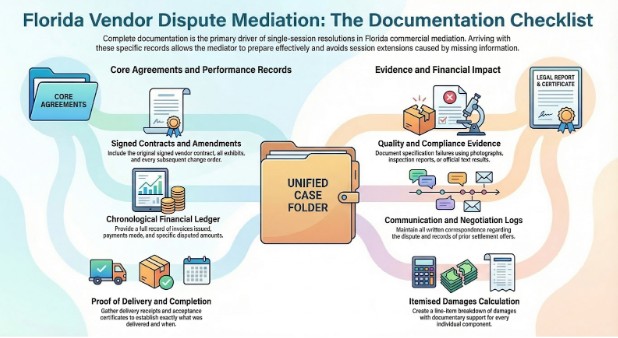
Florida B2B vendor dispute mediation produces faster outcomes when the initiating party arrives with a complete documentation file. A Florida commercial mediator’s pre-session preparation depends entirely on the documents the parties provide — incomplete documentation extends the session and reduces the probability of single-session resolution.
Bring these seven documents to every Florida vendor dispute mediation:
A Florida vendor contract dispute resolution clause that mandates mediation before arbitration or litigation protects both parties from unnecessary court costs and preserves the supply relationship.
A well-drafted clause turns a potential $100,000 litigation into a $5,000 mediation.
Non-material contract breach claims frequently arise from ambiguously drafted provisions in vendor contracts. A precisely drafted dispute resolution clause eliminates threshold litigation over whether the clause applies before the substantive dispute is addressed.
Florida SaaS and technology contract disputes involve categories that standard vendor frameworks do not address: service level agreement failures, data access disputes, intellectual property ownership claims over custom-developed software, and subscription termination fee disputes.
Florida businesses contracting for SaaS and technology services require dispute resolution clauses specifically drafted for these categories.
SLA disputes arise when the vendor and customer disagree on whether a measured performance failure meets the contractual threshold for a remedy.
SLA mediation requires position summaries that include the monitoring data, the SLA calculation methodology, and the disputed credit amount — technical documentation that a general vendor dispute rarely requires.
A Florida business whose SaaS vendor terminates the contract or becomes insolvent faces an immediate dispute over data access. Data access disputes require rapid resolution because the business’s operational continuity depends on data retrieval. Florida circuit court emergency injunctive relief is frequently the correct first step, with mediation addressing the underlying payment dispute immediately after data access is secured.
Florida technology services contracts involving custom software development require explicit IP ownership provisions.
When the contract is silent on IP ownership, a dispute arises over whether the deliverable belongs to the customer who paid for it or the vendor who created it.
Contract disputes over IP ownership are resolved more efficiently through mediation than through litigation because the parties can structure licensing arrangements and revenue-sharing terms that courts cannot impose.
Florida distribution and supply chain disputes involve multiple parties across contract tiers — manufacturer, distributor, sub-distributor, and retailer — creating overlapping contractual obligations that bilateral dispute resolution processes handle inefficiently.
Florida commercial mediation resolves multi-party supply chain disputes by bringing all affected parties to a single session.
A Florida distribution dispute between a manufacturer and a distributor frequently implicates sub-distributor agreements, retailer purchase orders, and third-party logistics contracts simultaneously.
A circuit court judgment in the manufacturer-distributor dispute does not resolve the sub-distributor’s competing claims.
Florida commercial mediation addresses all affected parties in a single session, producing a coordinated resolution that allocates responsibility across the supply chain without spawning serial litigation.
Florida distribution agreement terminations trigger disputes over outstanding inventory, unfilled purchase orders, and post-termination non-compete enforcement. Termination disputes require rapid resolution because both parties face ongoing financial exposure.
Industrial real estate disputes tied to distribution warehouse arrangements often accompany territory disputes — mediation addresses both the breach of the distribution agreement and the real property conflict in a single process.
Florida B2B contract disputes are governed by two parallel legal frameworks: Article 2 of the Florida UCC under Chapter 672 of the Florida Statutes for goods contracts, and Florida common law for service agreements.
Florida courts apply a pro-enforcement framework to both vendor contracts and dispute resolution clauses — written agreements are enforced as written.
Florida Statutes 672.101 through 672.725 govern contracts for the sale of goods between Florida businesses. Key provisions include: the perfect tender rule under Florida Statute 672.601; the cure right under Florida Statute 672.508; the cover remedy under Florida Statute 672.712; and the four-year statute of limitations under Florida Statute 672.725.
Florida service contracts are governed by Florida common law contract principles. Florida common law requires each party to perform contractual obligations in good faith and in a commercially reasonable manner.
The statute of limitations for Florida written service contract breach claims is five years under Florida Statute 95.11(2)(b).
Florida Statute 671.203 imposes a good-faith obligation on every party to a Florida commercial contract. A buyer cannot reject conforming goods on pretextual quality grounds, and a vendor cannot invoke technical contract language to avoid liability for clear performance failures.
Florida commercial mediators use the good-faith standard as an analytical framework in caucus, helping each party evaluate whether their position would survive a good-faith challenge in the Florida circuit court.
Most Florida vendor disputes settle in a single mediation day, not over a single trial year. Book David L. John, Florida Certified Circuit Court Mediator, at commercialdisputeresolutiongroup.com.
What is the most common Florida vendor contract dispute?
Non-payment disputes are the most common type of Florida vendor contract dispute, followed by quality failures, scope disagreements, and non-delivery claims under Florida UCC Article 2.
Does Florida law require mediation before suing a vendor?
Florida courts enforce mandatory mediation clauses in vendor contracts as conditions precedent to litigation and dismiss lawsuits filed without first satisfying the mediation requirement.
How long does vendor contract mediation take in Florida?
Florida vendor contract mediation typically concludes within 2 to 6 weeks of the initial mediation proposal, with a signed settlement agreement or a declared impasse.
What documents should I bring to a vendor dispute mediation?
Florida vendor dispute mediation requires the signed contract, all invoices and payment records, delivery documentation, quality evidence, written communications, and a line-item damages calculation.
Can a mediated vendor settlement agreement be enforced in Florida?
A signed Florida-mediated vendor settlement agreement is enforceable as a binding written contract and is subject to a breach-of-contract action in the Florida circuit court if either party defaults.
What is the statute of limitations for Florida vendor contract disputes?
Florida UCC goods contract disputes carry a four-year limitation under Florida Statute 672.725. Florida written service contract disputes carry five years under Florida Statute 95.11(2)(b).