


Data last verified: March 2026
Alternative dispute resolution (ADR) is the collective term for structured dispute resolution processes that resolve legal conflicts outside of court, including negotiation, mediation, arbitration, and collaborative law. Florida ADR is governed primarily by Chapter 44 of the Florida Statutes for court-connected processes and Chapter 682 of the Florida Statutes for arbitration.
Florida businesses and their attorneys use ADR to resolve commercial disputes faster, more cheaply, and more privately than in circuit court litigation.
Florida ADR processes range from fully voluntary and non-binding — negotiation and mediation — to contractually mandatory and binding — arbitration and collaborative law agreements.
The method a Florida business uses depends on what its contract requires, what outcome it needs, and how much control it wants to retain over the result.
Stop paying litigation costs on disputes that mediation resolves in weeks. David L. John, Florida Certified Circuit Court Mediator, serves South Florida businesses at commercialdisputeresolutiongroup.com.
Alternative dispute resolution (ADR) is a structured set of processes for resolving legal disputes outside the public court system. Florida ADR encompasses negotiation, mediation, arbitration, and collaborative law — each producing a different level of formality, binding effect, and third-party involvement.
ADR is an alternative to Florida circuit court litigation, not a replacement for legal rights.
ADR is not a single process — it is a framework of four distinct methods that operate at different levels of formality and produce different legal outcomes. A Florida business that signs a contract containing an ADR clause has agreed in advance to resolve disputes through one or more of these methods before either party may file a lawsuit.
Florida ADR is not new. The Florida Legislature established a comprehensive ADR framework in Chapter 44 of the Florida Statutes in 1987 and has expanded it repeatedly since.
Florida circuit courts now refer virtually every civil case to mediation before trial under Florida Rule of Civil Procedure 1.700 — a recognition by the Florida judiciary that ADR resolves most commercial disputes more efficiently than full litigation.
Contract disputes, commercial real estate conflicts, design-build project disagreements, and industrial property disputes all qualify for Florida ADR processes.
Any civil dispute cognizable in a Florida circuit court can be resolved through ADR if the parties have agreed to it.
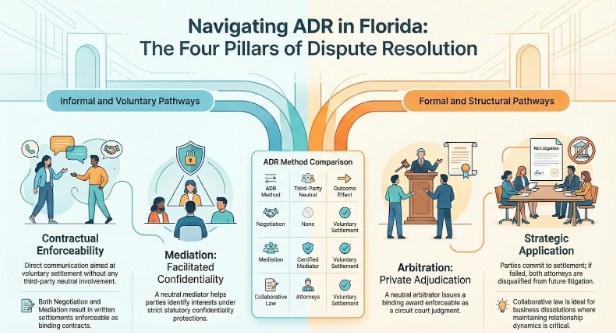
Florida ADR encompasses four primary methods: negotiation, mediation, arbitration, and collaborative law. Each method differs in three dimensions — the role of the third-party neutral, the binding effect of the outcome, and the procedural formality required.
Florida businesses select among these four methods based on the dispute category, the relationship at stake, and the outcome each party needs.
Negotiation is direct communication between the disputing parties — or their attorneys — aimed at reaching a voluntary settlement without any third-party neutral. Negotiation is the lowest-cost, fastest, and least formal ADR method.
A written settlement reached through negotiation is enforceable as a contract modification under Florida law. Negotiation is the correct first step in every Florida commercial dispute before any formal ADR process is initiated.
Florida commercial mediation is a confidential, facilitated negotiation process in which a neutral Florida Supreme Court-certified mediator helps disputing parties identify interests, evaluate litigation risk, and reach a voluntary written settlement.
The mediator holds no authority to impose an outcome — both parties control the result. Florida Statute 44.405 classifies all mediation communications as confidential and inadmissible in any subsequent proceeding.
A signed mediated settlement agreement is enforceable as a binding contract under Florida law.
Florida commercial arbitration is a private adjudication process governed by the Florida Arbitration Code, Chapter 682 of the Florida Statutes, in which a neutral arbitrator reviews evidence and issues a binding written award enforceable as a circuit court judgment.
Arbitration is more formal than mediation, produces a binding imposed decision, and eliminates most appellate rights.
Florida arbitration is the correct ADR method when the parties need a binding decision but want to preserve confidentiality and avoid full circuit court litigation costs and timelines.
Florida collaborative law is a structured negotiation process governed by the Florida Collaborative Law Process Act, Chapter 61 of the Florida Statutes, in which both parties and their attorneys commit in writing to resolving the dispute without litigation.
If collaborative law fails and either party files suit, both attorneys are disqualified from representing their clients in the subsequent litigation — a structural incentive that encourages genuine settlement efforts.
Collaborative law is used primarily in Florida family law disputes, but it also applies to business partnership dissolutions and closely held corporation exit disputes where relationship dynamics make traditional negotiation ineffective.
Florida ADR processes deliver measurable advantages over circuit court litigation across five dimensions: cost, timeline, privacy, outcome control, and finality.
Florida businesses that select the appropriate ADR method for their dispute category resolve disputes faster, more cheaply, and more privately than through circuit court litigation — while retaining greater control over the outcome.
| Factor | Negotiation | Mediation | Arbitration | Circuit Court Litigation |
| Timeline | Days–2 weeks | 2–6 weeks | 3–12 months | 18 months–3+ years |
| Total cost | Minimal | $1,500–$8,000 | $15,000–$60,000 | $25,000–$150,000+ |
| Privacy | Full | Full — Fla. Stat. 44.405 | Full | Public court record |
| Outcome control | Both parties | Both parties | Arbitrator decides | The judge or jury decides |
| Binding effect | Contract if written | Contract if signed | Final — Fla. Stat. 682.15 | Court judgment |
| Appeal rights | N/A | N/A | Very limited | Full appellate review |
| Relationship impact | Minimal | Low | Moderate | High — often permanent |
| Attorney required? | Optional | Optional but advisable | Effectively required | Effectively required |
Florida circuit courts order mediation in virtually every civil case under Florida Rule of Civil Procedure 1.700.
A Florida business that files a lawsuit without first attempting ADR pays full discovery costs — depositions at $500 to $2,000 each, expert witness fees, motion practice, and pre-trial preparation — before arriving at a court-ordered mediation that ADR-first parties reach in week three of the dispute.
The litigation-first path adds $30,000 to $90,000 in costs to reach the same outcome.
Florida ADR processes produce four different levels of legal enforceability depending on the method used. Negotiated and mediated outcomes are binding only if reduced to a signed written agreement.
Arbitration awards are binding final judgments enforceable through Florida circuit courts. Collaborative law participation agreements are binding on the attorneys’ disqualification — the substantive outcome is binding only if reduced to a signed settlement.
| ADR Method | Binding? | Enforcement Mechanism |
| Negotiation | Only if written and signed | Florida contract law — breach of contract action |
| Mediation | Only if written and signed | Florida contract law — breach of contract action |
| Arbitration | Yes — final award | Florida Statute 682.15 — circuit court confirmation |
| Collaborative law | Attorneys are disqualified if litigation is filed | Florida Statute 61.57 — participation agreement |
A Florida-mediated settlement agreement signed by both parties is an enforceable written contract under Florida law. A party that breaches the terms of a signed mediated settlement agreement faces a breach-of-contract action in a Florida circuit court.
When mediation occurs after a lawsuit is filed, the parties may file the mediated settlement agreement under Florida Rule of Civil Procedure 1.730 and have it entered as a circuit court consent judgment enforceable through liens, garnishment, and levy.
A binding Florida arbitration award is final and enforceable as a circuit court judgment under Florida Statute 682.15.
Florida courts may vacate a binding arbitration award only on the four narrow grounds in Florida Statute 682.13: fraud, arbitrator corruption, serious procedural misconduct, or the arbitrator exceeding their authority. An arbitrator’s legal error alone does not constitute a valid ground for vacatur.
Florida law mandates ADR in specific dispute categories and authorizes Florida circuit courts to order ADR in virtually all civil cases.
Florida businesses operating in construction, insurance, family law, and certain regulated industries face statutory ADR requirements that apply regardless of what their contracts say.
Florida Rule of Civil Procedure 1.700 authorizes Florida circuit courts to refer any civil case to mediation at any time.
In practice, Florida circuit courts order mediation in the overwhelming majority of commercial civil cases before setting a trial date.
A Florida business that files a lawsuit without first attempting mediation will almost certainly be ordered to mediate anyway — after paying full pre-trial litigation costs.
Florida Statute 558.004 requires a property owner asserting a construction defect claim to serve written notice on the contractor and allow a defined inspection and cure period before filing suit.
This pre-suit notice requirement functions as a mandatory ADR prerequisite — the contractor’s response to the notice frequently resolves the dispute without litigation.
Design-build disputes and construction contract conflicts are among the most common Florida disputes where statutory ADR prerequisites apply.
Florida Statute 627.7015 establishes a mandatory mediation program for certain Florida insurance disputes, requiring insurers to offer mediation before a policyholder may initiate appraisal or litigation on a residential property insurance claim.
Beyond statutory mandates, Florida courts enforce contractual ADR requirements as conditions precedent to litigation. A Florida business that files a circuit court lawsuit without satisfying a mandatory mediation or arbitration clause faces dismissal or a stay pending compliance.
Material contract breach claims arising from ADR clause violations are adjudicated under Florida contract law — the clause is treated as a binding contractual obligation, not a procedural suggestion.
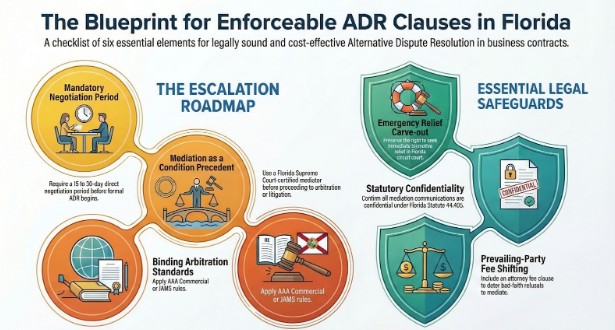
A Florida business contract ADR clause specifies the dispute resolution method, the neutral selection process, the governing procedural rules, the seat of any arbitration, and the escalation path from negotiation through final resolution.
A well-drafted ADR clause prevents threshold litigation over which process applies and gives both parties a clear, cost-controlled path to resolution before a dispute materializes.
Florida construction contracts require ADR clauses that address the pre-suit notice requirement under Florida Statute 558.004. Florida technology services contracts require provisions addressing data access continuity during the dispute period.
Florida commercial lease agreements require provisions addressing rent payment obligations and possession rights pending resolution of the underlying dispute. Non-material contract breach claims arising from ambiguously drafted ADR clauses produce threshold litigation over whether the clause applies — precise drafting eliminates that gateway dispute entirely.
A Florida ADR neutral is a trained, credentialed third party who facilitates or decides a dispute without being a party to it. Florida law establishes distinct qualification requirements for mediators and arbitrators — the qualifications differ significantly, and selecting an unqualified neutral risks producing an unenforceable outcome.
Florida mediators are credentialed by the Florida Supreme Court through the Florida Dispute Resolution Center. Florida Supreme Court mediator certification tiers correspond to the court level at which the mediator may practice:
| Certification Tier | Court Level | Qualification Requirements |
| County Court Mediator | County court civil cases | 20 hours training + 8 observed mediations |
| Circuit Court Mediator | Circuit court civil and family cases | 40 hours training + 8 observed mediations + supervised co-mediations |
| Dependency Mediator | Dependency court cases | Specialized training in child welfare |
| Appellate Mediator | Appellate court cases | Circuit mediator certification + additional training |
Florida commercial disputes handled at the circuit court level require a Florida Supreme Court-certified Circuit Court Mediator. The Florida Dispute Resolution Center maintains the official Florida mediator registry.
Florida commercial arbitrators are not required to hold state certification. The Florida Arbitration Code, under Chapter 682 of the Florida Statutes, does not establish minimum qualifications for arbitrators. Arbitrator quality is controlled through administrator rosters — AAA and JAMS maintain qualification standards for arbitrators on their Florida commercial rosters, including subject-matter experience requirements and disclosure obligations under Florida Statute 682.041.
Florida businesses select the appropriate ADR method by applying a four-question decision framework: What does the contract require?
Does the dispute require a binding imposed decision or a negotiated outcome? Does the business relationship need to be preserved? And what is the realistic cost-benefit of each available path?
Question 1: What does the contract say? Review the dispute resolution clause before selecting any process. A mandatory mediation clause requires mediation first. A binding arbitration clause requires arbitration for unresolved disputes. A contract silent on dispute resolution leaves all options open. Florida courts enforce dispute resolution clauses as written — selecting a non-contractual process creates a threshold dispute before the substantive claim is addressed.
Question 2: Do you need a binding imposed decision? If both parties are willing to negotiate a resolution, mediation is the correct first step — it costs less, resolves faster, and preserves the relationship. If the opposing party refuses to negotiate in good faith or the dispute requires a definitive legal determination, arbitration or litigation produces the binding outcome that mediation cannot impose.
Question 3: Does the business relationship need to survive? Contract disputes between ongoing business partners, commercial real estate co-owners, and supply chain participants require resolution methods that preserve the relationship. Mediation is the only ADR method that produces outcomes both parties construct together. Arbitration and litigation produce imposed decisions that typically terminate the business relationship.
Question 4: What is the realistic cost-benefit? For disputes below $50,000, arbitration fees and attorney costs can consume a disproportionate share of the recovery; mediation or direct negotiation produces better net outcomes. For disputes above $500,000 where the opposing party refuses to engage in good-faith negotiations, arbitration delivers a binding result more quickly and more cheaply than circuit court litigation.
ADR Method Selection Summary
| Dispute Scenario | Recommended Method |
| Ongoing relationship, negotiable dispute | Mediation first |
| Contract requires a specific process | Follow the contract |
| Need a binding decision, value confidentiality | Arbitration |
| Emergency injunctive relief required | Circuit court — file immediately |
| Dispute below $25,000 | Negotiation or county court |
| Multi-party supply chain conflict | Multi-party mediation |
| Partnership or LLC deadlock | Mediation — governance restructuring |
| Statutory ADR requirement applies | Follow the statute |
What does ADR stand for in Florida law?
ADR stands for alternative dispute resolution — the collective term for negotiation, mediation, arbitration, and collaborative law processes that resolve disputes outside the Florida circuit court under Chapter 44 of the Florida Statutes.
Is ADR binding in Florida?
The ADR binding effect depends on the method. Arbitration awards are binding under Florida Statute 682.15. Mediated and negotiated settlements are binding only when reduced to a signed written agreement enforceable as a Florida contract.
Does Florida require ADR before filing a lawsuit?
Florida Rule of Civil Procedure 1.700 authorizes courts to order ADR in any civil case. Florida Statute 558.004 requires pre-suit notice in construction defect claims. Contractual ADR clauses are enforced as conditions precedent to litigation by Florida courts.
What qualifications must a Florida mediator hold?
Florida circuit court commercial mediators must hold Florida Supreme Court certification as Circuit Court Mediators, requiring 40 hours of mediation training and supervised practice hours verified by the Florida Dispute Resolution Center.
What is the difference between mediation and arbitration in Florida?
Florida mediation is a facilitated negotiation producing a voluntary settlement — the mediator holds no decision-making authority. Florida arbitration is a private adjudication producing a binding award — the arbitrator decides the dispute. Mediation preserves party control; arbitration transfers it to the arbitrator.
How do I add an ADR clause to a Florida business contract?
A Florida business contract ADR clause requires six elements: a mandatory negotiation period, a mediation requirement naming a Florida-certified mediator, a binding arbitration clause for unresolved disputes, an emergency relief carve-out, a confidentiality confirmation, and a prevailing-party fee-shifting provision.
Most Florida vendor disputes settle in a single mediation day, not over a single trial year. Book David L. John, Florida Certified Circuit Court Mediator, at commercialdisputeresolutiongroup.com.