

Data last verified: March 2026
Commercial arbitration in Florida is a private, binding dispute resolution process in which one or more neutral arbitrators evaluate evidence from both parties and issue a final, court-enforceable award.
Florida commercial arbitration operates under Chapter 682 of the Florida Statutes and replaces circuit court litigation for any business dispute covered by a written arbitration clause. Most Florida commercial arbitrations reach a final award within 3 to 12 months of filing.
David L. John is a Florida Certified Circuit Court Mediator and commercial dispute resolution specialist serving South Florida businesses. Schedule a free online consultation at commercialdisputeresolutiongroup.com.
Commercial arbitration is a private adjudication process in which a neutral arbitrator replaces the court, reviews evidence from both parties, and issues a binding written award enforceable under Florida law.
Florida commercial arbitration applies to contract, real estate, construction, and general business disputes in which the parties have executed a written agreement to arbitrate rather than litigate.
Commercial arbitration places decision-making authority in a neutral arbitrator — not a judge — who reviews evidence, evaluates arguments, and issues a written decision called an award.
A binding arbitration award carries the same legal force as a Florida circuit court judgment and is subject to confirmation and enforcement under Florida Statute 682.15.
Florida commercial arbitration covers six primary dispute categories: contract breaches, real estate purchase disputes, construction defects, commercial lease disputes, design-build project disputes, and business ownership disputes involving outside investors.
Any civil dispute cognizable in a Florida circuit court qualifies for arbitration when the parties have executed a valid written agreement to arbitrate.
Chapter 682 of the Florida Statutes treats written arbitration agreements as enforceable contracts and authorizes Florida circuit courts to compel arbitration when a valid clause exists, and one party refuses to participate.
Binding arbitration produces a final, court-enforceable Florida award that neither party can unilaterally reject. Non-binding arbitration produces an advisory decision that either party may decline without legal consequence.
Florida commercial contracts default to binding arbitration because binding arbitration delivers dispute finality without returning the matter to the circuit court.
A binding Florida arbitration award is final and legally compels both parties to comply. The prevailing party may confirm the award as a circuit court judgment under Florida Statute 682.15 and enforce it through standard civil collection mechanisms.
Florida Statute 682.13 limits vacatur to four grounds: corruption, fraud, arbitrator misconduct, or the arbitrator exceeding their authority.
Non-binding arbitration produces an advisory decision that either party may reject in favor of circuit court litigation.
Florida circuit courts occasionally order non-binding arbitration as a pretrial settlement mechanism, but commercial parties rarely select it voluntarily because it adds procedural costs without guaranteeing a resolution.
Parties who accept a non-binding outcome may reduce it to a written settlement agreement.
Binding arbitration is the default in Florida commercial contracts. AAA model clauses, JAMS-recommended language, and most standard Florida industry agreements default to binding arbitration.
Non-binding arbitration primarily appears in court-ordered pretrial settings or in the insurance and construction industries, where advisory decisions serve a defined procedural function.
Florida commercial arbitration results in a binding decision by a chosen neutral arbitrator. Florida mediation is a facilitated negotiation in which a neutral mediator assists parties in reaching a voluntary settlement but issues no ruling and holds no decision-making authority.
Florida circuit court litigation resolves disputes through the public judicial system under the Florida Rules of Civil Procedure.
| Factor | Commercial Arbitration | Circuit Court Litigation |
| Timeline | 3–12 months typical | 18 months to 3+ years |
| Privacy | Fully confidential | Public court record |
| Cost | $5,000–$50,000+ (see cost section) | Often higher with discovery |
| Decision-maker | Chosen arbitrator(s) | Assigned judge or jury |
| Formality | Streamlined rules | Full civil procedure rules |
| Appeal rights | Very limited | Full appellate review |
| Flexibility | Scheduling by agreement | Court calendar controls |
Many Florida commercial contracts include a tiered dispute resolution clause requiring commercial mediation as a mandatory first step before arbitration may be initiated.
A tiered clause preserves each party’s ability to settle cooperatively while guaranteeing a binding endpoint if mediation fails.
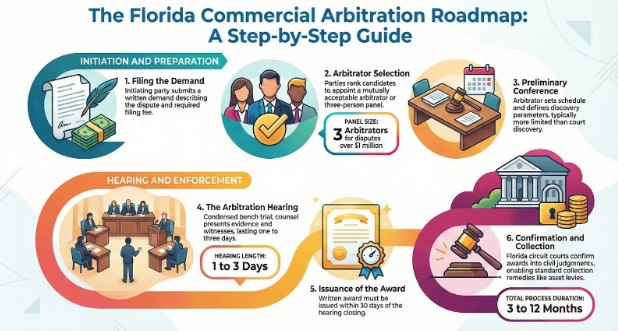
Florida commercial arbitration under the AAA Commercial Rules proceeds through seven sequential stages: demand filing, arbitrator selection, preliminary conference, pre-hearing evidence exchange, the arbitration hearing, post-hearing briefs, and issuance of the written award.
Most AAA-administered Florida commercial arbitrations complete all seven stages within 3 to 12 months.
The initiating party files a written Demand for Arbitration with the designated administrator — the American Arbitration Association (AAA), JAMS, or the forum named in the contract.
The demand identifies both parties, describes the nature of the dispute, states the amount at issue, and specifies the relief requested. AAA requires simultaneous payment of the applicable filing fee at submission.
The administrator distributes a ranked list of qualified arbitrators to both parties. Each party ranks candidates in order of preference and strikes unacceptable names.
The administrator appoints the highest-ranked mutually acceptable arbitrator. Florida commercial disputes exceeding $1 million in value typically proceed before a three-arbitrator panel.
The appointed arbitrator conducts an initial scheduling conference to establish the hearing date, define discovery parameters, and resolve any jurisdictional or procedural objections.
Florida commercial arbitrations typically permit limited document exchange and depositions by mutual agreement — far less extensive than discovery in Florida circuit courts.
Each party submits pre-hearing briefs, documentary exhibits, and witness lists within the schedule set at the preliminary conference. The arbitrator may issue preliminary orders resolving procedural disputes or ruling on whether specific claims fall within the scope of the arbitration agreement.
A Florida commercial arbitration hearing functions as a condensed bench trial. Counsel delivers opening statements, examines and cross-examines witnesses, introduces documentary evidence, and argues legal positions. The Florida Rules of Evidence apply in relaxed form. Most Florida commercial arbitration hearings conclude within one to three hearing days.
After the hearing closes, the arbitrator issues a written award within the deadline established by the applicable rules — 30 days under the AAA Commercial Arbitration Rules. Awards take either a standard or a reasoned form.
AAA requires the arbitrator to issue a reasoned award upon request by either party before the hearing closes.
Either party may petition a Florida circuit court to confirm the arbitration award as a civil judgment under Florida Statute 682.15. A confirmed award is enforceable through all standard Florida civil collection remedies: judgment liens, wage garnishment, and asset levy.
David L. John brings more than 30 years of direct commercial dispute experience across construction, real estate, and contract conflicts throughout South Florida. Call (954) 444-2900 or visit commercialdisputeresolutiongroup.com.
An enforceable Florida arbitration clause requires four elements: clear mutual agreement binding both parties, a defined scope of covered disputes, a named procedural forum, and Florida designated as the arbitration seat.
One-sided clauses and undefined-scope language are the two drafting failures that Florida courts most frequently cite when refusing to enforce or narrowing an arbitration agreement.
Florida courts strike one-sided arbitration clauses — those permitting only one party to compel arbitration — as procedurally unconscionable. Clauses omitting a designated procedural forum generate threshold motions over applicable rules before the substantive dispute is heard.
Overly narrow scope language produces satellite litigation over whether a specific claim falls inside or outside the clause.
Any Florida commercial contract with a potential dispute value exceeding $25,000 requires review of the arbitration clause by a Florida-licensed business attorney at the contract formation stage — not after a dispute materializes.
The American Arbitration Association (AAA) and JAMS are the two dominant private arbitration administrators in the United States. Both organizations manage case administration, maintain qualified arbitrator rosters, collect filing and administrative fees, and set procedural timelines.
The administrator named in a Florida commercial contract determines the applicable fee schedule, arbitrator pool, and procedural defaults for any future dispute.
The American Arbitration Association is the largest arbitration administrator in the United States. AAA’s Commercial Arbitration Rules govern most Florida business disputes filed with AAA.
AAA serves as the default administrator in most standard Florida industry contracts — including commercial real estate purchase agreements and construction contracts — and maintains a Florida arbitrator roster with demonstrated experience in commercial real estate disputes and contract conflicts.
JAMS is a private arbitration administrator specializing in large, complex commercial disputes. JAMS attracts a roster of retired Florida judges and senior litigators as arbitrators. JAMS fees exceed AAA fees, and JAMS is typically selected for Florida commercial disputes exceeding $1 million or involving complex legal questions where judicial arbitrator experience adds measurable value. JAMS maintains a Florida-specific arbitrator roster covering Broward, Miami-Dade, and Palm Beach counties.
The administrator named in a Florida commercial contract controls three outcomes before any dispute arises: the fee schedule, the arbitrator roster, and the procedural defaults.
Florida courts allow either party to petition for the appointment of an arbitrator under Florida Statute 682.04 when a contract names no administrator. Naming the wrong forum — or no forum — generates a gateway procedural dispute before the substantive case is ever heard.
Florida commercial arbitration costs scale with three variables: the amount in dispute, the administrator selected, and the arbitrator’s daily rate. A two-day AAA arbitration of a $300,000 Florida commercial dispute — including arbitrator, AAA administrative, and attorney fees — commonly totals between $15,000 and $50,000, which is lower than comparable circuit court litigation for the same dispute value.
AAA Commercial Fee Schedule (2026 Reference)
| Dispute Amount | AAA Filing Fee (approx.) | Arbitrator Fee (daily) |
| Under $75,000 | $775–$1,700 | $1,000–$2,500 |
| $75K–$300,000 | $1,700–$3,400 | $1,500–$3,500 |
| $300K–$1 million | $3,400–$6,200 | $2,000–$5,000 |
| Over $1 million | $6,200+ | $3,000–$7,500+ |
The above AAA arbitrator fees reflect a single hearing day. Most Florida commercial arbitrations require two to five days of arbitration, covering pre-hearing file review, the hearing itself, and deliberation. Parties split arbitrator fees equally unless the contract or the award specifies a different allocation.
JAMS charges a 12% administrative fee calculated on total arbitrator compensation, in addition to its own case filing fee.
A two-arbitrator-day JAMS proceeding at $4,000 per arbitrator day generates approximately $960 in JAMS administrative fees on top of the base arbitrator cost.
JAMS is materially more expensive than AAA for mid-sized Florida commercial disputes but competitively priced for disputes exceeding $1 million, where arbitrator experience justifies the premium.
Florida follows the American Rule of attorney fee allocation: each party bears its own attorney fees unless a contract provision or a Florida statute authorizes fee shifting to the prevailing party.
Prevailing-party attorney fee provisions in Florida commercial contracts are enforceable through the arbitration award.
Attorney fees for contested Florida commercial arbitrations typically range from $15,000 to $75,000 or more and must be factored into any cost comparison with circuit court litigation.
Florida commercial arbitration delivers its strongest cost advantage in disputes valued between $75,000 and $500,000. For disputes below $25,000, per-day arbitrator fees risk consuming a disproportionate share of any recovery.
For disputes exceeding $1 million, the total cost gap between arbitration and circuit court litigation narrows, but arbitration continues to deliver faster resolution and full confidentiality of proceedings.
Binding Florida commercial arbitration awards are final by design. A Florida circuit court may vacate a binding award only on the four statutory grounds defined in Florida Statute 682.13.
Legal error by the arbitrator — even a clear, material error of Florida law — does not constitute a valid basis for vacatur under the Florida Arbitration Code or the Federal Arbitration Act.
Florida Statute 682.13 authorizes a Florida circuit court to vacate a binding arbitration award on four grounds only:
Arbitrator legal error — including clear misapplication of Florida contract law or evidentiary rules — does not justify vacatur under Florida Statute 682.13.
The Florida Supreme Court and federal courts applying the Federal Arbitration Act have consistently held that judicial review of arbitration awards does not extend to the merits of the arbitrator’s legal reasoning.
AAA and JAMS each offer optional appellate arbitration rules that parties may incorporate by reference in their original contract. Under these rules, a separate arbitration panel — not a Florida circuit court — reviews the initial award for defined errors.
Optional appellate arbitration adds time and cost but provides a contractual review mechanism for high-value Florida commercial disputes in which award finality without a backstop is unacceptable to both parties.
The Florida Arbitration Code — Chapter 682 of the Florida Statutes — is the primary statutory framework governing the formation, enforcement, conduct, and judicial review of commercial arbitration agreements and awards in Florida.
The Florida Legislature substantially revised the Florida Arbitration Code in 2013 to align Florida arbitration law with the Revised Uniform Arbitration Act (RUAA).
Florida Statute 682.02 requires a written arbitration agreement for the clause to be enforceable under Florida law. Florida courts broadly interpret the writing requirement to include electronic contracts and email confirmations, provided the parties’ intent to arbitrate is unambiguous.
Florida Statute 682.03 authorizes a party to petition the circuit court to compel arbitration when the opposing party refuses to arbitrate a dispute covered by a valid clause.
Florida courts must compel arbitration upon finding a valid agreement and a covered dispute, and must simultaneously stay any pending circuit court litigation until arbitration concludes.
Florida Statute 682.041 requires every Florida arbitrator to disclose, before appointment, any facts that could affect the arbitrator’s impartiality — including financial relationships with either party, prior dealings, and prior arbitration service in related matters.
Failure to disclose a material fact is a statutory basis for vacating the resulting award under Florida Statute 682.13.
Florida Statute 682.031 authorizes Florida circuit courts to grant provisional remedies — including temporary injunctions and asset attachments — before the appointment of an arbitrator and during pending arbitration proceedings. Provisional relief addresses a structural gap in arbitration: an arbitrator lacks authority to act before formal appointment, a process that typically requires several weeks.
The Federal Arbitration Act (FAA) preempts the Florida Arbitration Code when a commercial contract involves interstate commerce.
FAA coverage extends to most contracts between Florida businesses and out-of-state parties, as well as to contracts involving products or services that cross state lines.
Florida commercial attorneys analyze the applicability of the FAA versus the Florida Arbitration Code at the outset of every arbitration dispute because the controlling statute affects procedural rights and vacatur standards.
Florida commercial arbitration limits discovery, eliminates meaningful appellate rights, and imposes per-day arbitrator fees that can erode net recovery on low-value claims.
Identifying the dispute categories in which arbitration underperforms circuit court litigation helps Florida businesses make better contract-drafting decisions and smarter dispute-resolution strategy choices.
Florida arbitration awards are confidential and do not establish binding legal precedent. When a disputed legal question affects an entire Florida industry or business sector, circuit court litigation produces a public ruling that protects the prevailing party’s market position in future disputes — a result that arbitration cannot deliver.
Florida commercial arbitration limits discovery to document exchange and depositions by agreement, far less than discovery in Florida circuit court under the Florida Rules of Civil Procedure.
When the opposing party controls all material evidence — internal financial records, communications, or technical documentation — circuit court litigation provides subpoena power, compelled depositions, and forensic accounting mechanisms that arbitration does not.
For Florida commercial disputes below $25,000, per-day arbitrator fees and AAA or JAMS administrative costs can consume a disproportionate percentage of any recovery.
Florida small claims court (jurisdiction up to $8,000) and Florida county court (jurisdiction up to $30,000) deliver faster, lower-cost resolution for small commercial matters without arbitrator fees.
A Florida arbitrator holds no authority to issue a temporary injunction before formal appointment, and arbitrator appointment typically requires several weeks.
Florida businesses requiring immediate court-ordered relief — to stop a counterparty from transferring assets, misappropriating trade secrets, or breaching a non-compete — must file in a Florida circuit court.
Florida commercial contracts can address this gap by explicitly preserving emergency injunctive relief rights in circuit court while routing all other disputes to arbitration.
A Florida arbitration award against an insolvent counterparty produces no recoverable value. Florida circuit court litigation, combined with prejudgment attachment under Florida Statute 76.01 and creditor-priority mechanisms, provides stronger collection tools when the counterparty’s solvency is genuinely at risk.
Florida commercial attorneys recommend evaluating collectability before selecting arbitration as the dispute resolution mechanism.
Florida commercial disputes — including contract breaches, commercial real estate conflicts, and design-build project disputes — are frequently resolved through structured mediation at a fraction of the cost of arbitration.
A Florida Certified Circuit Court Mediator helps both parties quantify realistic litigation risk before either side commits to a formal arbitration process.
Design-build and construction disputes in South Florida settle through mediation before arbitration in the majority of cases, where a skilled mediator facilitates the process.
What is commercial arbitration in Florida?
Commercial arbitration in Florida is a private, binding adjudication process in which a neutral arbitrator evaluates evidence and issues a final, enforceable award resolving a business dispute. Florida commercial arbitration replaces circuit court litigation for parties who have executed a written arbitration agreement governed by Chapter 682 of the Florida Statutes.
Is arbitration binding in Florida?
Florida commercial arbitration is binding when both parties have executed a written binding arbitration agreement. A binding Florida arbitration award is enforceable as a circuit court judgment under Florida Statute 682.15 and subject to vacatur only on the four narrow grounds defined in Florida Statute 682.13: fraud, arbitrator misconduct, arbitrator partiality, or excess of authority.
How long does commercial arbitration take in Florida?
Florida commercial arbitrations administered under AAA Commercial Rules conclude in 3 to 12 months from demand filing to final award. Florida circuit court litigation for comparable commercial disputes typically requires 18 months to 3 or more years. Complex multi-party Florida arbitrations — those involving large dispute values or extensive document discovery — may require 12 to 18 months, depending on arbitrator scheduling and agreed discovery scope.
What is the Florida Arbitration Code?
The Florida Arbitration Code is Chapter 682 of the Florida Statutes, the primary Florida statute governing formation, enforceability, conduct, and judicial review of commercial arbitration agreements and awards. The Florida Legislature revised the Florida Arbitration Code in 2013 to align Florida arbitration law with the Revised Uniform Arbitration Act.
Can I appeal a commercial arbitration award in Florida?
Florida circuit courts may vacate a binding commercial arbitration award only on the four statutory grounds in Florida Statute 682.13: fraud, arbitrator corruption or partiality, serious procedural misconduct, or the arbitrator exceeding their authority. Arbitrator’s legal error — including a clear misapplication of Florida law — does not constitute a valid ground for vacatur under the Florida Arbitration Code or the Federal Arbitration Act.
What is the difference between arbitration and mediation in Florida?
Florida commercial arbitration produces a binding decision from a neutral arbitrator carrying the force of a circuit court judgment. Florida mediation is a facilitated negotiation process in which a neutral mediator assists parties in reaching a voluntary settlement agreement but holds no authority to impose an outcome.
How much does commercial arbitration cost in Florida?
Florida commercial arbitration costs depend on the dispute value, the administrator’s selection, and the arbitrator’s daily rate. AAA filing fees range from $775 for disputes under $75,000 to $6,200 or more for disputes exceeding $1 million. Arbitrator daily rates range from $1,000 to $7,500 or more.
What types of commercial disputes can be arbitrated in Florida?
Florida commercial arbitration covers six primary dispute categories: contract breaches, commercial real estate disputes, industrial real estate conflicts, design-build project disputes, business ownership conflicts, and construction defect claims. Any civil dispute cognizable in a Florida circuit court qualifies for arbitration when the parties have executed a valid written arbitration agreement.
Ready to resolve your Florida commercial dispute efficiently and confidentially? David L. John, Florida Certified Circuit Court Mediator, offers free online consultations at commercialdisputeresolutiongroup.com or by calling (954) 444-2900.