


Data last verified: March 2026
Business partnership and LLC dispute mediation in Florida is a confidential, structured negotiation process in which a Florida Supreme Court-certified mediator helps co-owners resolve profit disputes, buyout disagreements, decision deadlocks, and breaches of the operating agreement without dissolving the business or filing a lawsuit.
Mediation preserves the company, the business relationship, and the financial value that litigation destroys.
Florida business partnership mediation applies to general partnerships, limited partnerships, LLCs, and closely held corporations governed by Florida Statutes Chapters 605, 607, and 620.
Most Florida partnership disputes reach a signed mediated settlement agreement within one to three session days at a total cost of $3,000 to $12,000 — compared to $50,000 to $200,000 or more for dissolution litigation.
Florida businesses resolve commercial disputes more quickly and more cheaply through mediation. David L. John, Florida Certified Circuit Court Mediator, accepts referrals at commercialdisputeresolutiongroup.com.
Business partnership and LLC disputes are structurally different from arm’s-length commercial disputes because the parties share ongoing financial interests, governance authority, and legal obligations that continue throughout the conflict.
A Florida circuit court judgment resolves an arm’s-length contract dispute and terminates the relationship. In a partnership dispute, that same judgment can destroy the business that both parties have built.
A Florida business partnership dispute is not a transaction gone wrong — it is a relationship breakdown inside a going concern. Contract disputes between co-owners of a company that has employees, customers, and market value carry consequences that extend beyond the legal claim itself.
Every month, the dispute continues in litigation, and that value erodes through management paralysis, customer attrition, and the operational costs of a divided leadership team.
Florida LLC members and business partners carry fiduciary duties to each other under Florida law. Florida Statute 605.04091 imposes a duty of loyalty and a duty of care on every Florida LLC manager.
A dispute that escalates to circuit court litigation requires each party to simultaneously fulfill those fiduciary duties and litigate against the person to whom those duties run — a structural contradiction that mediation resolves by addressing both the legal dispute and the governance relationship in a single process.
Commercial real estate disputes between co-owning business partners carry a further complication: the real property asset depreciates in value during prolonged ownership disputes.
Design-build and construction partnership disputes carry the same urgency — active projects stall, subcontractor relationships deteriorate, and bonding capacity shrinks while the partners litigate.
Florida business partnership and LLC disputes cluster around four primary triggers: disputed buyout valuations, profit distribution disagreements, management decision deadlocks, and breach-of-operating-agreement claims.
Each trigger carries distinct legal dimensions under Florida law and distinct mediation dynamics that a Florida-certified commercial mediator navigates differently.
A Florida LLC member or business partner seeking to exit the company requires a buyout at fair value. Florida Statute 605.0701 governs dissociation of LLC members and the resulting buyout obligation. The most common dispute is not whether a buyout is owed but what the company is worth.
Business valuation disputes between partners involve competing methodologies — the income approach, market approach, and asset approach — that can differ by 30% to 100% or more for the same company.
Mediation resolves buyout valuation disputes by bringing both parties’ valuation assumptions into a structured negotiation. A single jointly retained appraiser, agreed upon in mediation, produces a faster and cheaper valuation than competing expert witnesses in circuit court.
Florida LLC operating agreements govern profit distribution timing, allocation percentages, and reinvestment decisions. Disputes arise when one member claims distributions are being withheld improperly or when members disagree on whether profits should be reinvested or distributed.
Contract dispute principles govern operating agreement interpretation — Florida courts enforce operating agreement terms as written, making the agreement’s specific language the starting point for every mediation session.
A 50/50 Florida LLC or partnership reaches deadlock when the two members hold equal voting authority and cannot agree on a material business decision: a major capital expenditure, a new contract, a lease renewal, or a management hire.
Florida Statute 605.0413 addresses member voting and deadlock mechanisms in Florida LLCs. Deadlock mediation does not require the parties to resolve their underlying relationship — it requires them to agree on a governance mechanism that allows the business to function while the broader dispute is addressed.
A Florida LLC member who violates the operating agreement’s terms — by competing with the company, diverting business opportunities, or exceeding management authority — triggers a breach of contract claim governed by both Florida contract law and the Florida Revised LLC Act.
Material contract breach principles apply to operating agreement violations that go to the heart of the membership arrangement. Mediation addresses both the legal breach claim and the remediation terms in a single session.
Florida LLC member disputes are governed by the Florida Revised Limited Liability Company Act, codified at Chapter 605 of the Florida Statutes, which became effective January 1, 2015.
Chapter 605 establishes default rules for member voting, profit allocation, dissociation, and judicial dissolution that apply when the LLC operating agreement is silent, making the operating agreement the first document every Florida commercial mediator reviews before a partnership dispute session.
Florida Statute 605.0407 establishes that, absent operating agreement provisions to the contrary, Florida LLC decisions in the ordinary course of business require approval of members holding a majority of the voting interests.
Decisions outside the ordinary course require unanimous approval. This default framework creates a deadlock risk in any Florida LLC where two members hold equal voting interests and disagree on whether a decision qualifies as ordinary course.
Florida Statute 605.0601 establishes the events triggering a member’s dissociation from a Florida LLC. A dissociated member loses governance rights but retains an economic interest in the company.
Florida Statute 605.0701 governs the buyout obligation triggered by dissociation. A dissociated Florida LLC member who cannot negotiate a buyout price may petition the circuit court for a judicial determination of fair value under Florida Statute 605.0703.
| Mechanism | How It Works | Best For |
| Mediation | Neutral mediator facilitates negotiated resolution | All deadlock types — first step always |
| Buy-sell provision | One party names a price; the other buys or sells at that price | 50/50 deadlocks with clear asset values |
| Tie-breaking manager | The operating agreement names a third manager with a casting vote | Recurring governance deadlocks |
| Arbitration clause | The binding decision by the chosen arbitrator | Deadlocks requiring a final imposed decision |
| Judicial dissolution | The Florida circuit court dissolved the LLC | Last resort when all else fails |
Florida minority shareholders in closely held corporations hold specific statutory protections under the Florida Business Corporation Act, Chapter 607 of the Florida Statutes.
Florida Statute 607.1430 authorizes a minority shareholder to petition a Florida circuit court for judicial dissolution when the majority engages in oppressive conduct, wastes corporate assets, or deadlocks the board.
Mediation resolves minority shareholder disputes by addressing the oppression claim directly—frequently through a negotiated buyout—without triggering the costly dissolution proceedings.
Florida Statute 607.1430 permits a minority shareholder to seek judicial dissolution when the directors act in a manner that is illegal, oppressive, or fraudulent toward the minority shareholder.
Florida courts broadly interpret oppressive conduct to include freezing out the minority from distributions, terminating minority shareholders’ employment without cause, and excluding the minority from material business decisions.
Each of these triggers presents a mediation opportunity. The majority can remedy oppressive conduct through a negotiated buyout or governance reform rather than face a dissolution proceeding that destroys the company for both parties.
Shareholder Dispute Resolution Paths
| Path | Timeline | Cost | Outcome |
| Mediation | 2–8 weeks | $3,000–$15,000 | Negotiated buyout or governance reform |
| Shareholder arbitration | 3–9 months | $15,000–$60,000 | Binding arbitrator decision |
| Florida circuit court | 18 months–3+ years | $50,000–$200,000+ | Judge-imposed remedy or dissolution |
| Voluntary buyout | Weeks | Negotiation costs only | Clean exit for one party |
A Florida minority shareholder who files a dissolution petition under Florida Statute 607.1430 forces the majority to choose between buying out the minority at a court-determined price and dissolving the company.
Mediation gives the majority a third option — negotiating buyout terms directly with the minority before the court sets the price.
The majority almost always achieves a lower buyout cost through mediation than through judicial valuation. The minority almost always achieves a faster exit. Both parties avoid the legal fees, public record, and operational disruption of a dissolution proceeding.
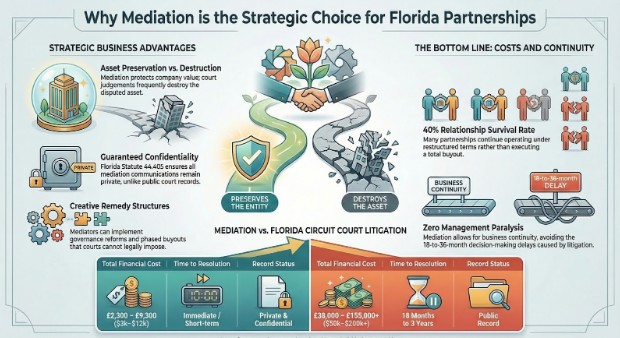
Florida business partnership and LLC disputes are resolved through mediation at higher rates than arm’s-length commercial disputes because both parties share a continuing economic interest in the company’s survival.
A Florida circuit court judgment in a partnership dispute frequently destroys the asset both parties are fighting over — mediation preserves it.
Florida partnership mediation delivers five specific advantages over litigation:
Florida commercial mediation moves faster when both parties arrive prepared. Call David L. John at (954) 444-2900 or visit commercialdisputeresolutiongroup.com to schedule.
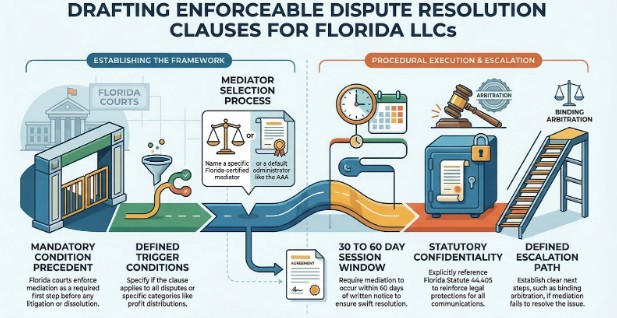
A Florida LLC operating agreement dispute-resolution clause that mandates mediation before litigation or dissolution protects all members from the financial destruction caused by premature court proceedings.
A well-drafted clause specifies the trigger conditions, the mediator selection process, the session timeline, and the escalation path when mediation fails.
The Six Elements of an Enforceable Florida Dispute Resolution Clause
Florida LLC operating agreement dispute-resolution clauses most often fail because they omit the mediator-selection process, fail to specify a timeline, or include an arbitration clause that conflicts with the mediation requirement without establishing a clear sequence.
A Florida business attorney should review the dispute resolution clause at operating agreement formation — not after the first member dispute materializes.
Non-material contract breach claims frequently arise from ambiguously drafted provisions in operating agreements.
A precisely drafted dispute resolution clause eliminates the threshold litigation over whether the clause applies before the substantive dispute is ever addressed.
Florida business partnership and LLC disputes are resolved without dissolution in the majority of cases, where both parties retain an economic interest in the company’s continued operation. Florida circuit courts treat dissolution as a remedy of last resort.
Mediation produces three dissolution-alternative outcomes: a negotiated buyout, a governance restructuring, or a profit-sharing modification.
A negotiated buyout through mediation allows one partner to exit the company at an agreed valuation without the cost of a judicial valuation proceeding. The buyout terms — price, payment structure, non-compete scope, and transition obligations — are negotiated directly between the parties with the mediator’s facilitation.
A phased buyout structure, in which the exiting partner receives payments over 12 to 36 months from company cash flow, resolves disputes where the remaining partner lacks the immediate liquidity for a lump-sum payment.
Industrial real estate disputes between co-owning partners frequently use phased buyout structures tied to the property’s rental income stream.
Florida LLC operating agreements can be amended by member agreement at any time. When a partnership dispute stems from governance dysfunction — undefined decision-making authority, unclear management roles, or inadequate deadlock mechanisms — mediation produces an operating agreement amendment that restructures governance without requiring either party to exit.
A governance restructuring mediation outcome frequently includes a revised management authority matrix, a defined deadlock resolution process, and a scheduled buyout option at a pre-agreed valuation formula.
When a Florida partnership dispute centers on distribution disagreements rather than governance conflict, mediation produces a profit-sharing modification that addresses the underlying financial grievance without changing ownership structure.
A profit-sharing modification mediation outcome specifies distribution timing, reinvestment thresholds, and draw schedules in terms both parties accept — removing the dispute’s financial trigger while preserving the partnership.
Florida business partnership mediation that reaches impasse leaves three escalation paths: binding arbitration under a contractual arbitration clause, a Florida circuit court buyout proceeding under Florida Statute 605.0703, or a judicial dissolution proceeding under Florida Statute 605.0702.
Each escalation path carries distinct cost, timeline, and outcome implications that Florida commercial attorneys evaluate against the specific facts of the dispute.
A Florida LLC operating agreement that includes a binding arbitration clause requires the parties to submit unresolved disputes to a neutral arbitrator whose decision is final and enforceable as a circuit court judgment.
Commercial arbitration under AAA Commercial Arbitration Rules resolves most Florida business partnership disputes in 3 to 12 months at a total cost of $15,000 to $60,000 — slower and more expensive than mediation but significantly faster and cheaper than circuit court litigation.
Florida Statute 605.0703 authorizes a Florida circuit court to order a buyout of a dissociated LLC member at fair value when the parties cannot agree on a buyout price.
The circuit court appoints a valuation expert, receives competing appraisals, and determines fair value — a process that takes 12 to 24 months and costs $30,000 to $100,000 or more in combined expert and attorney fees.
A mediated buyout at an agreed valuation almost always costs less and closes faster than a court-ordered buyout proceeding. The financial gap between a mediated outcome and a judicial valuation outcome is the strongest argument for attempting mediation before filing.
Florida Statute 605.0702 authorizes a Florida circuit court to judicially dissolve an LLC when the members cannot reasonably agree on how to conduct the company’s activities or when the company’s management is deadlocked, and the deadlock is causing irreparable harm.
Judicial dissolution is the most destructive outcome for all parties — it terminates the company, forces a liquidation of assets at distressed values, and distributes proceeds after satisfying all company obligations.
Florida circuit courts treat dissolution as a last resort and actively encourage mediation before granting dissolution relief.
A Florida commercial attorney who files for dissolution without first attempting mediation risks a court-ordered mediation referral that adds cost and delay to the dissolution timeline.
Can Florida LLC members be forced to mediate a dispute?
Florida LLC members can be contractually required to mediate under an operating agreement clause. Florida courts enforce mandatory mediation clauses and dismiss litigation filed without first satisfying the mediation requirement.
What Florida law governs LLC member disputes?
Florida LLC member disputes are governed by Chapter 605 of the Florida Statutes — the Florida Revised Limited Liability Company Act — covering voting, profit allocation, dissociation, and judicial dissolution.
How is a Florida LLC buyout valuation determined in mediation?
Florida LLC buyout valuations in mediation are determined through negotiation, often using a single jointly retained appraiser rather than competing expert witnesses, thereby significantly reducing costs and time.
Can a minority shareholder stop a Florida LLC dissolution?
A Florida minority shareholder cannot unilaterally prevent a dissolution, but may petition the circuit court for a buyout remedy under Florida Statute 607.1430 as an alternative to dissolution.
What happens to a Florida LLC operating agreement during a dispute?
A Florida LLC operating agreement remains fully in force during a member dispute. All members retain their contractual rights and fiduciary duties under Florida Statute 605.04091 until a mediated settlement modifies those terms.
How long does Florida business partnership mediation take?
Florida business partnership mediation typically concludes in 2 to 8 weeks from the initial agreement to mediate, including position summary exchange and 1 to 3 session days, depending on the dispute’s complexity.
Your client’s commercial dispute deserves resolution, not years in court. Refer your case to David L. John at commercialdisputeresolutiongroup.com.