


Data last verified: March 2026
Florida commercial mediation is a structured, confidential negotiation process governed by Florida Statute 44.405 in which a Florida Supreme Court-certified mediator facilitates settlement between disputing parties.
Florida attorneys who integrate mediation into their dispute resolution strategy reduce client costs by 60% to 80%, compress timelines from years to weeks, and deliver measurable outcomes that build long-term referral relationships.
Florida commercial mediation applies to contract breaches, real estate disputes, construction conflicts, and business ownership disagreements — any civil dispute cognizable in a Florida circuit court.
Most Florida commercial mediations reach a signed settlement agreement or declared impasse within a single session.
Florida businesses resolve commercial disputes more quickly and more cheaply through mediation. David L. John, Florida Certified Circuit Court Mediator, accepts referrals at commercialdisputeresolutiongroup.com.
Florida commercial attorneys who recommend mediation before filing deliver three measurable client outcomes: lower total dispute cost, faster resolution, and preserved business relationships.
Florida circuit court litigation consumes 30% to 60% of the dispute value in attorney fees and costs before reaching trial — a cost structure that mediation eliminates in most cases.
The financial case for mediation-first is straightforward. A Florida business disputing a $200,000 breach-of-contract claim spends $40,000 to $80,000 to reach a trial date in circuit court. Pre-suit mediation for the same dispute costs $2,000 to $8,000 total.
The attorney who surfaces that difference at intake retains the client for every subsequent matter.
Beyond cost, Florida commercial mediation produces outcomes that litigation cannot. Mediated settlements preserve supplier relationships, partnership arrangements, and commercial lease continuations that a circuit court judgment permanently terminates.
Contract disputes between long-term business partners are resolved through mediation in the majority of cases, with a skilled mediator facilitating the session.
Florida courts reinforce the mediation-first posture. Under Florida Rule of Civil Procedure 1.700, Florida circuit courts order mediation in virtually every civil case — meaning litigation-first parties pay full discovery costs before arriving at the same mediation table they could have reached in week three of the dispute.
Florida commercial attorneys apply a three-factor decision framework: whether the contract mandates a specific process, whether the client needs a public precedent or emergency relief, and whether the opposing party’s participation is predictable.
Mediation is the correct first recommendation in the majority of Florida commercial disputes where none of those three factors compel a different path.
| Factor | Mediation | Arbitration | Litigation |
| Contract clause | Pre-suit mediation clause | Binding arbitration clause | No ADR clause |
| Emergency relief needed | No | No | Yes — file immediately |
| Public precedent needed | No | No | Yes |
| Relationship preservation | Priority | Secondary | Not a factor |
| Discovery volume needed | Low | Moderate | High |
| Dispute value | Any | $75,000+ | Any |
| Timeline priority | Fastest | Moderate | Slowest |
A binding arbitration clause in the underlying contract removes the choice — Florida courts compel arbitration under Florida Statute 682.03 when a valid clause exists, and a party refuses to participate.
When the contract is silent, arbitration is preferable over litigation for disputes exceeding $75,000 where the client needs a binding decision but values confidentiality and speed over full appellate rights.
Review the material and non-material contract breach pages to assess which dispute category applies to the client’s specific facts.
Florida circuit court litigation is the correct path when the client requires immediate injunctive relief, needs court-enforceable subpoenas for third-party evidence, or seeks a public judgment that protects market position in future disputes.
Commercial real estate disputes involving title clouds or third-party encumbrances frequently require circuit court jurisdiction that mediation cannot provide.
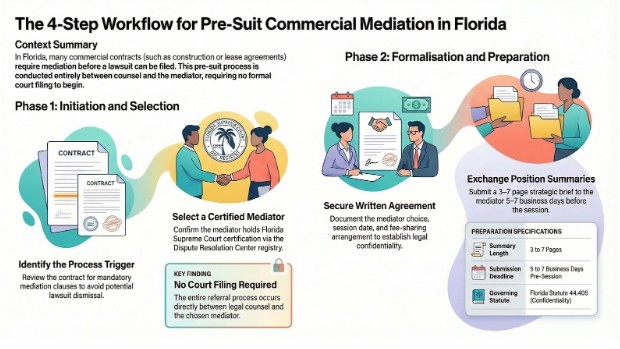
Florida commercial mediation referral follows four steps: identify the applicable process trigger, select and contact a Florida Supreme Court-certified mediator, secure the opposing party’s written agreement to mediate, and establish the session date and position summary exchange deadline.
No court filing is required for pre-suit mediation — the entire referral process occurs between counsel and the mediator.
Review the underlying contract for a pre-suit mediation clause before any other step. Florida commercial contracts — particularly construction agreements, commercial leases, and business partnership operating agreements — frequently require mediation before either party may file suit.
Florida courts enforce these clauses and have dismissed lawsuits filed without satisfying the pre-suit mediation requirement.
Florida mediators handling circuit court-level commercial disputes must hold certification from the Florida Supreme Court as Circuit Court Mediators. The Florida Dispute Resolution Center maintains the official Florida mediator registry.
Contact the mediator directly to confirm availability, subject-matter experience, and fee structure before proposing the mediator to opposing counsel.
Send a written mediation proposal to opposing counsel identifying the mediator, proposed session date, position summary exchange deadline, and fee-sharing arrangement. Document the opposing party’s acceptance in writing.
The written agreement to mediate establishes the confidentiality framework under Florida Statute 44.405 and creates a record of the pre-suit mediation step for any subsequent litigation.
Each party submits a written position summary — typically 3 to 7 pages — to the mediator 5 to 7 business days before the session.
The position summary is the attorney’s first strategic document in the mediation process and directly shapes the mediator’s pre-session preparation and approach to caucus questioning.
Mediator selection is the single most controllable variable in Florida commercial mediation outcomes. A mediator with deep subject-matter experience in the specific dispute category — construction defects, commercial lease conflicts, or business ownership disputes — prepares more targeted questions, identifies the realistic settlement zone faster, and moves both parties toward agreement more efficiently than a generalist mediator.
| Style | Approach | Best For |
| Evaluative | Assesses merits, shares opinion in caucus | One party holds an unrealistic litigation valuation |
| Facilitative | Focuses on interests, avoids merit opinions | Relationship preservation is the primary goal |
| Transformative | Empowers parties to reframe the dispute | Partnership or ownership conflicts with emotional stakes |
| Hybrid | Shifts style based on session dynamics | Complex multi-party commercial disputes |
A Florida mediator with 20 years of construction litigation experience brings comprehensive industry knowledge to a design-build dispute that a general commercial mediator lacks.
That experience shortens caucus time, reduces session length, and lowers total mediation cost. Confirm the mediator’s specific case history in the dispute category — not just their general certification level — before proposing a name to opposing counsel.
Confirm the mediator’s availability for the preferred session date, the standard fee structure, the cancellation policy, and whether sessions are conducted in person, via video conference, or both.
Industrial real estate disputes and multi-party construction claims increasingly use video conference platforms to reduce travel costs and scheduling friction across Florida counties.
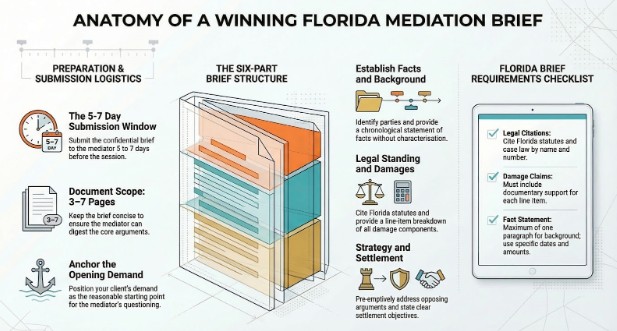
A Florida commercial mediation brief is a 3 to 7-page confidential document submitted to the mediator 5 to 7 days before the session.
A well-constructed brief frames the dispute in your client’s favor, quantifies litigation risk for the opposing party, and positions your client’s opening demand as the reasonable anchor for the mediator’s caucus questioning.
Florida commercial mediation briefs fail most often for three reasons. Briefs written in litigation tone — adversarial, procedural, and citation-heavy — signal that the attorney has not shifted into settlement mode.
Briefs that omit the damages calculation give the mediator nothing to anchor caucus discussions. Briefs submitted the day before the session leave the mediator insufficient time to prepare, reducing session efficiency and lengthening the day.
Florida commercial mediation moves faster when both parties arrive prepared. Call David L. John at (954) 444-2900 or visit commercialdisputeresolutiongroup.com to schedule.
Florida commercial mediation clients who enter the session understanding the process, their role, and the mediator’s function settle at significantly higher rates than unprepared clients.
Client preparation requires a single focused pre-mediation meeting that covers session structure, the mediator’s role, caucus dynamics, and the client’s decision-making authority regarding settlement terms.
Florida commercial attorneys function as strategic advisors during mediation, not advocates performing for a judge.
The attorney’s session responsibilities include framing the client’s opening statement, providing legal context during caucuses, evaluating settlement proposals against litigation risk, and drafting or reviewing the settlement agreement language before the client signs.
Present the client’s position in plain, business-oriented language — not legal argument. The joint session audience is the opposing party, not a judge. Statements that acknowledge the business relationship and demonstrate good-faith engagement move the mediation toward settlement faster than adversarial openings that entrench both parties in their starting positions.
Use private caucus time to provide the mediator with the legal context that strengthens your client’s position: the controlling Florida statute, the relevant contract language, and the damages methodology.
The mediator carries that framing into the opposing party’s caucus. Attorneys who repeat joint session positions during caucus — rather than adding legal depth — waste the most productive phase of the session.
Review every term of the proposed settlement agreement before your client signs. A signed Florida mediated settlement agreement becomes an enforceable contract immediately.
Ambiguous payment terms, undefined performance obligations, and missing mutual release language create enforcement disputes that cost more than the original mediation.
For contract disputes and commercial real estate matters, include a prevailing-party attorney-fee clause in the settlement agreement to deter post-settlement defaults.
Florida Statute 44.405 makes all mediation communications — statements, offers, admissions, and documents produced solely for mediation — confidential and inadmissible in any subsequent judicial, arbitral, or administrative proceeding.
The confidentiality protection covers all participants: parties, attorneys, and the mediator, regardless of how the mediation concludes.
Florida Statute 44.405 protects every communication made during a mediation session: oral statements in joint sessions and caucuses, written settlement proposals exchanged during the session, and concessions or admissions made while evaluating settlement terms.
A party that offered $90,000 in caucus cannot have that offer introduced as evidence of liability valuation in subsequent litigation.
Florida Statute 44.405 does not protect documents that exist independently of the mediation.
A contract, invoice, financial statement, or email produced during discovery and also presented in mediation retains its normal admissibility — the statute protects mediation-specific communications, not underlying evidence.
Pre-existing documents do not acquire mediation confidentiality by being presented during a session.
Florida attorneys must advise clients of the confidentiality protections before the mediation session and must not attempt to introduce mediation communications in subsequent proceedings.
A Florida attorney who attempts to use a mediation admission as evidence violates Florida Statute 44.405 and exposes the client to a motion to strike and potential sanctions under Florida Rule of Civil Procedure 1.380.
A mediated settlement agreement signed by both parties in Florida is enforceable as a written contract under Florida contract law. A party that breaches a signed mediated settlement agreement is subject to a breach-of-contract action in a Florida circuit court.
Florida courts confirm mediated settlement agreements as circuit court judgments when the agreement is filed under Florida Rule of Civil Procedure 1.730.
When a party defaults on payment or performance obligations in a signed mediated settlement agreement, the non-defaulting party files a breach of contract action in a Florida circuit court.
The signed agreement is the operative contract — the plaintiff proves the agreement’s terms, the defendant’s breach, and the resulting damages. Florida courts do not re-examine the underlying dispute; they enforce the agreement as written.
When mediation occurs after a lawsuit has been filed, the parties may file the mediated settlement agreement with the circuit court under Florida Rule of Civil Procedure 1.730. The court enters a consent judgment incorporating the agreement’s terms, enforceable through judgment liens, garnishment, and levy.
Florida commercial attorneys maximize the enforceability of mediated settlement agreements by including: full legal names of both parties, specific payment amounts and deadlines, defined performance obligations with measurable completion criteria, and a mutual release of all claims arising from the dispute.
Florida as governing law, a prevailing-party attorney-fee provision for any enforcement action, and a confession-of-judgment clause for payment obligations, allowing the payee to obtain a circuit court judgment upon default without a separate lawsuit.
A Florida commercial mediation that reaches impasse does not prejudice either party’s litigation rights, waive any claims, or create admissible evidence. Florida Statute 44.405 protects all mediation communications regardless of outcome.
An impasse reveals the opposing party’s settlement floor, litigation posture, and case theory at a cost far below what discovery would produce.
Within 24 hours of an impasse, prepare a confidential attorney work-product memo that records the opposing party’s stated positions, the mediator’s observations regarding each party’s litigation risk tolerance, and the settlement range the mediator identified as realistic.
This memo informs litigation strategy, discovery prioritization, and any renewed settlement discussions.
A party that refuses to move below a demand exceeding any realistic jury award signals a litigation posture worth testing through early dispositive motions.
A party that holds firm on a position supported by strong documentary evidence signals that a case requires early settlement discussions rather than full trial preparation.
Florida commercial mediations that reach impasse after limited pre-suit information exchange frequently settle after targeted discovery narrows the factual disputes.
A second mediation session, held after document production but before depositions begin, resolves a significant percentage of Florida commercial cases that reached impasse in the first session.
When litigation becomes unavoidable, file promptly and move the case efficiently through discovery.
Commercial real estate disputes, industrial property conflicts, and design-build project claims that reach litigation after failed mediation typically settle during the discovery phase when the costs of continued litigation become concrete to both parties.
Your client’s commercial dispute deserves resolution, not years in court. Refer your case to David L. John at commercialdisputeresolutiongroup.com.
What qualifications must a Florida commercial mediator hold?
Florida commercial mediators handling circuit court disputes must hold Florida Supreme Court certification as Circuit Court Mediators, requiring 100 hours of mediation training and supervised practice.
When must a Florida attorney recommend mediation to a client?
Florida attorneys must recommend mediation when the underlying contract contains a mandatory pre-suit mediation clause — Florida courts enforce these clauses and dismiss lawsuits filed without satisfying the requirement.
What does a Florida mediation brief contain?
Florida commercial mediation brief identifies the parties, states the operative facts chronologically, presents the legal position with statute citations, provides a line-item damages calculation, and addresses the opposing party’s likely arguments.
Can mediation communications be used in Florida litigation?
Florida Statute 44.405 classifies all mediation communications as confidential and inadmissible in any subsequent judicial, arbitral, or administrative proceeding, covering all participants regardless of outcome.
How is a mediated settlement agreement enforced in Florida?
A signed Florida-mediated settlement agreement is enforceable as a written contract through a breach-of-contract action or, when filed under Florida Rule of Civil Procedure 1.730, as a circuit court consent judgment.
What should a Florida attorney do after mediation reaches an impasse?
After the impasse, prepare a confidential work-product memo recording the opposing party’s revealed positions, evaluate the litigation path against what mediation disclosed, and propose a second mediation after targeted discovery.